
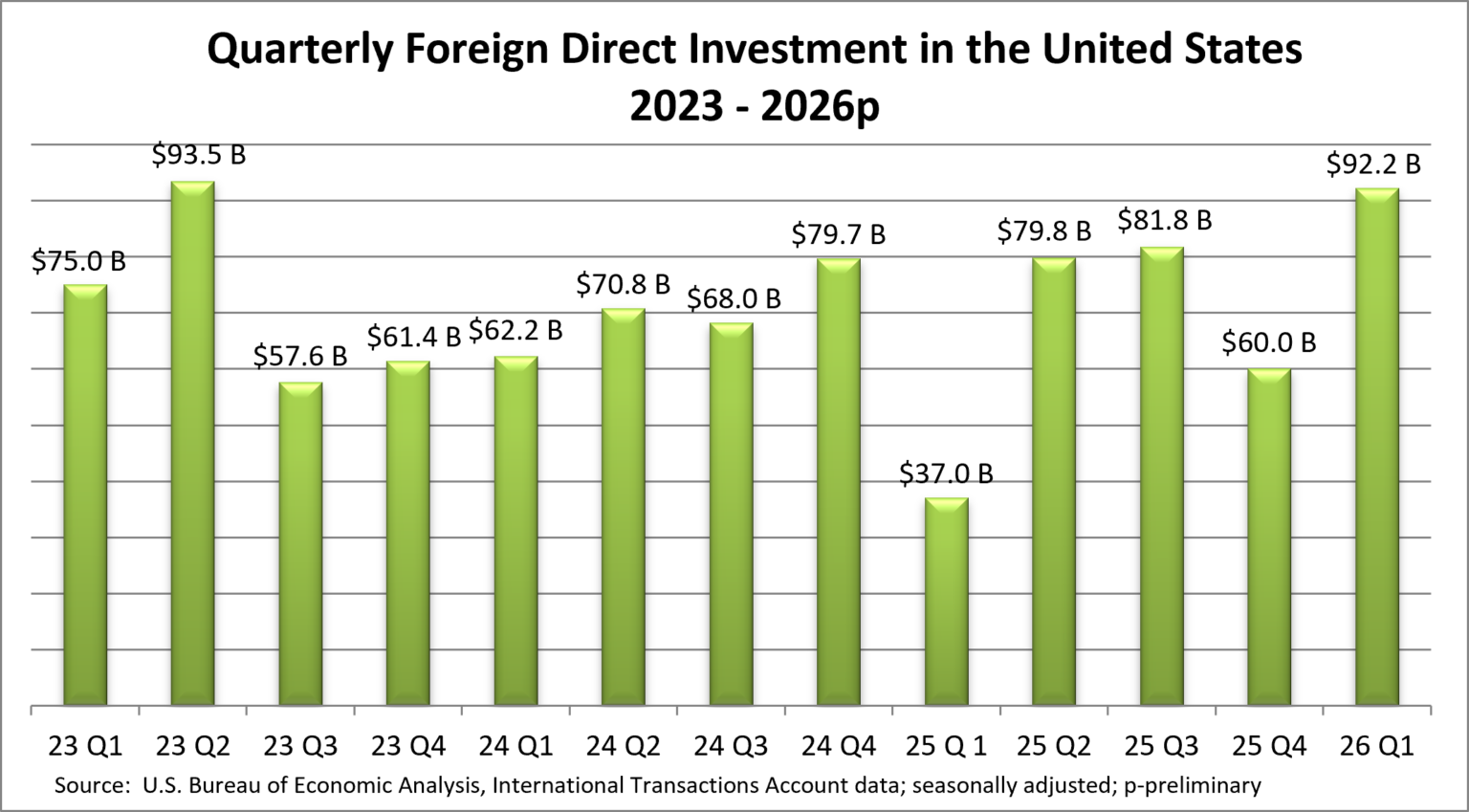
- Foreign direct investment in the United States (FDIUS) reached $92 billion in the first quarter of 2026, growing more than 50 percent over the fourth quarter of 2025.
- Net equity flows totaled $28 billion in the first quarter of 2026, representing an 82 percent increase compared to the $15 billion recorded in the previous quarter.
- Reinvested earnings reached $62 billion in the first quarter of 2026, accounting for 68 percent of total FDIUS.
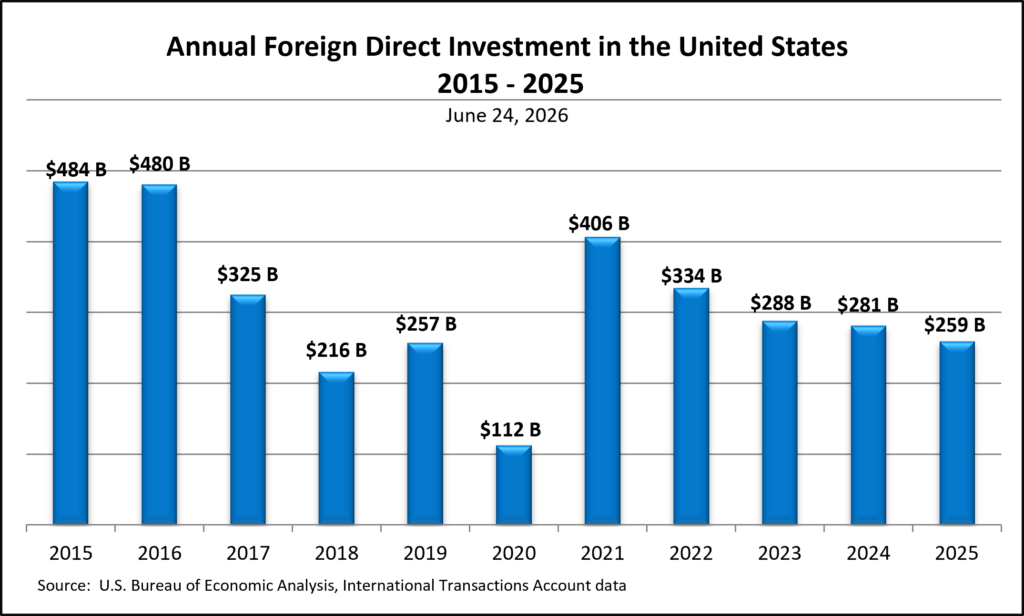
- At $259 billion, foreign direct investment in the United States for 2025 was revised downward, remained below the decade’s annual average, and marked an 8 percent decline from 2024 levels.
- Because quarterly FDIUS data are subject to frequent and substantial adjustments, quarterly inflows often show significant volatility from one period to the next.
- Despite intensifying global competition, the United States maintains its status as the world’s premier destination for foreign capital. A vast consumer base, sophisticated financial markets, and robust legal protections provide an unmatched environment for international investors. This sustained influx catalyzes job creation, accelerates innovation, and cements America’s competitive edge on the world stage.
Analysis & Context
Foreign direct investment flows into the United States grew 54 percent to reach $92 billion in the first quarter of 2026. This was the second-best quarter over the past three years. Reinvested earnings continued to serve as the primary driver of FDIUS at 68 percent in the first quarter of 2026. Meanwhile, equity flows surged 82 percent from the fourth quarter of 2025, totaling $28 billion. The annual totals of FDIUS were all revised downward since 2022. Foreign direct investment in the United States in 2025 was revised from $288 billion to $259 billion.
Luxembourg and Canada emerged as the leading sources of FDIUS in the first quarter of 2026, each contributing more than $15 billion in capital. South Korea, the Netherlands, and Japan rounded out the top five investors.
Manufacturing dominated FDIUS inflows in the first quarter of 2026 at $28 billion, followed by wholesale trade and finance and insurance, at $20 billion and $10 billion, respectively. Within the manufacturing sector, electrical equipment, appliances, and components ranked as the largest segment, attracting more than $11 billion in foreign capital.
Global FDI rose 14 percent to $1.6 trillion in 2025, with inflows primarily favoring developed economies, according to the United Nations Conference on Trade and Development (UNCTAD). However, this growth was heavily influenced by conduit flows; stripping out these financial distortions reveals a more modest underlying increase of 5 percent. The investment landscape was defined by the digital economy: data centers accounted for one-fifth of all greenfield announced project value, while semiconductor investments surged 35 percent. Artificial intelligence rounded out the top three sectors, cementing the tech industry’s role as the primary engine for high-value investment.
The enduring appeal of the United States as a premier global investment destination arises from a unique convergence of strategic assets. Beyond its vast domestic market, the United States offers unparalleled access to world-class research institutions and a sophisticated infrastructure that streamlines market entry. Furthermore, international firms are increasingly utilizing the United States as a high-efficiency global export platform, further bolstered by abundant domestic energy resources that provide a distinct competitive advantage in manufacturing and operational costs.
These investments provide a vital catalyst for the American economy. International firms do more than just establish new manufacturing facilities; they modernize existing operations and strengthen domestic research and development. Most importantly, these companies provide a livelihood for 8.7 million Americans, offering high-quality, well-paying jobs that sustain local communities nationwide.
According to UNCTAD, the United States solidified its status as the world’s premier destination for FDI flows in 2025 and continues to lead as the largest cumulative market for international capital. This achievement, however, occurs against the backdrop of a volatile global landscape. While nations compete fiercely for capital, many are paradoxically implementing protectionist policies, ranging from heightened regulatory barriers to increasingly stringent oversight of cross-border mergers and acquisitions.
Sustaining the United States’ status as the world’s premier investment destination will depend on future political shifts and broader macroeconomic policy decisions, both at home and abroad. For the 14th consecutive year, the 2026 A.T. Kearney Foreign Direct Investment Confidence Index ranked the United States number one globally. However, the United States saw a decline in its overall score and investor optimism compared to the previous year. Canada secured the number two position for the fourth year running, notably increasing its score and closing the gap with the United States.