
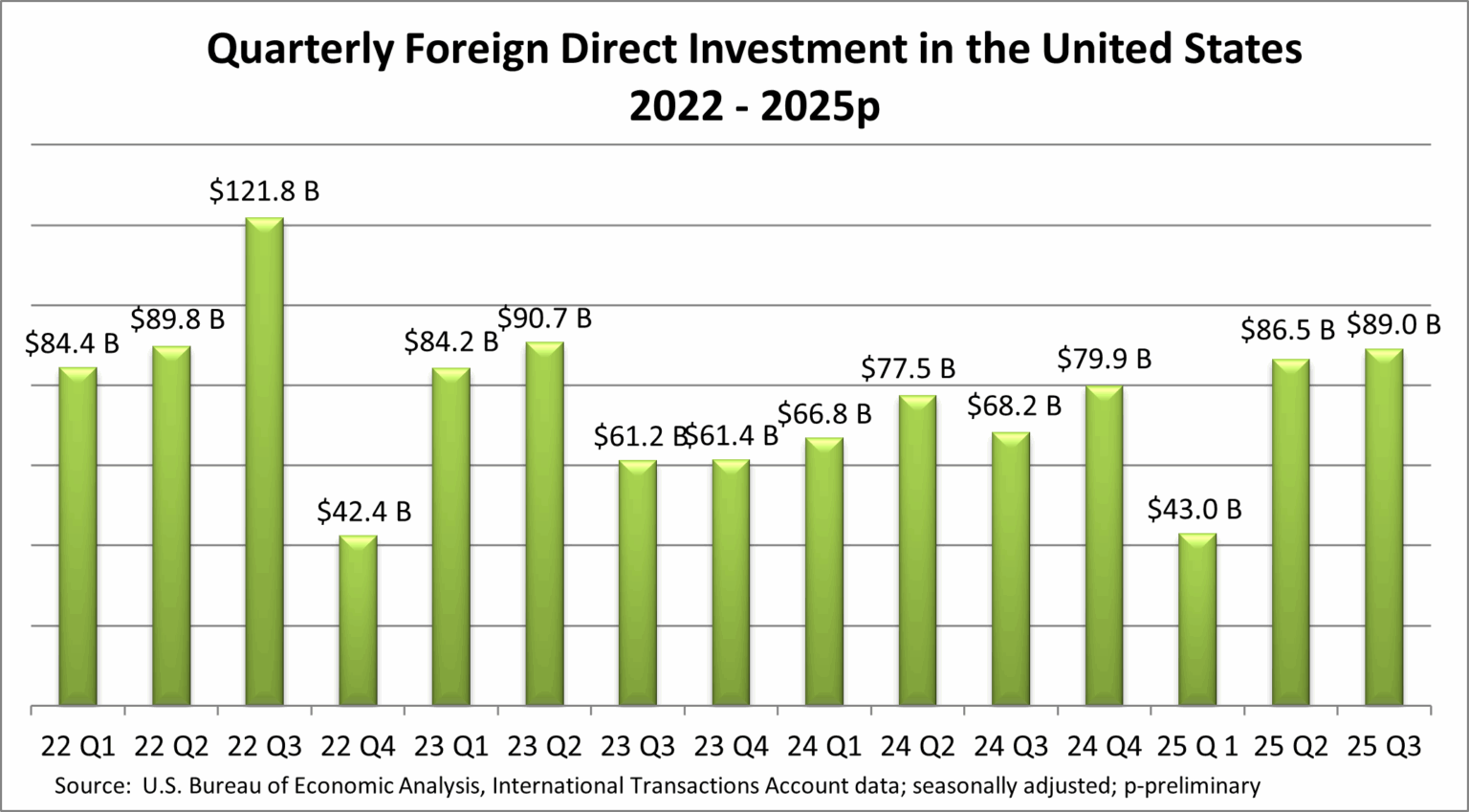
- Foreign direct investment in the United States (FDIUS) totaled $89 billion in the third quarter of 2025, a 3 percent increase over the second quarter of 2025.
- Net equity flows registered $41 billion in the third quarter of 2025, increasing 28 percent from the previous quarter.
- Reinvestment of earnings stood at $50 billion in the third quarter of 2025, accounting for 56 percent of FDIUS.
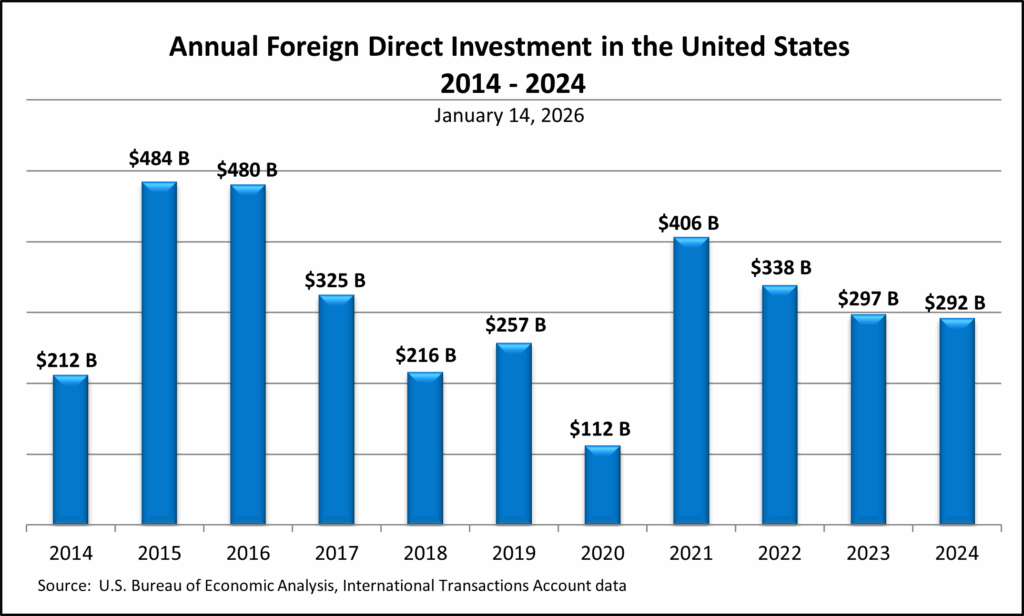
- Foreign direct investment in the United States in 2024 was $292 billion, making it a weaker-than-average year for FDIUS over the past decade.
- Quarterly FDIUS flows are subject to large revisions and can fluctuate greatly from quarter to quarter.
- Despite increased global competition for foreign investment, the United States remains a prime investment market that offers several significant advantages, including a large consumer base, developed financial markets, and strong legal protections for investors. Together, these advantages have long attracted foreign capital to the United States, which creates new jobs across the American economy, bolsters American innovation, and enhances America’s global competitiveness.
Analysis & Context
Foreign direct investment flows in the United States in the third quarter of 2025 totaled $89 billion, the highest level since the second quarter of 2023. Reinvested earnings made up the largest portion of FDIUS at 56 percent in the third quarter of 2025. Equity rose 28 percent between the second and third quarters of the year to $41 billion.
During the first nine months of 2025, Japan and the Netherlands were the top investors in the United States, each investing at least $29 billion. The United Kingdom, Germany, and Ireland completed the list of the top five investors in FDIUS flows during the same time period.
Manufacturing led in FDIUS flows in the first nine months of 2025 at $97 billion, followed by wholesale trade and information, at $27 billion and $19 billion, respectively. Chemicals ranked as the largest manufacturing segment by FDIUS at $31 billion.
Global FDI extended its three-year slump, with an additional 3 percent decline in the first half of 2025. Defying this global downturn, North America posted a 5 percent increase in inflows. The United States saw the value of its greenfield investments double to $237 billion in just six months—a surge the United Nations Conference on Trade and Development (UNCTAD) attributes mainly to artificial intelligence (AI)-related investments, with massive commitments to semiconductors and data centers.
Looking at foreign direct investment more broadly, international companies invest in the United States for many reasons. A list of positive factors includes the large U.S. market, world-class research universities, and a solid infrastructure that allows businesses to easily access the U.S. market. For certain international investors, the United States has become an important global export platform. Good domestic energy resources also draw international investors to the United States.
These investments benefit the American economy as international firms build new factories across the United States, buoy their well-established U.S. operations, fund American research and development activities, and employ 8.7 million Americans in well-paying jobs.
The United States was the world’s top destination for FDI flows in 2024, and cumulatively, it remains the world’s prime location for international investment. Most nations are eager to attract foreign investment, but many engage in protectionist activities, such as raising regulatory barriers for foreign investment and tightly monitoring cross-border mergers and acquisitions.
The United States’ ability to maintain its position as the world’s most appealing investment location depends on political and policy changes, along with macroeconomic policy decisions, both in the United States and abroad.