
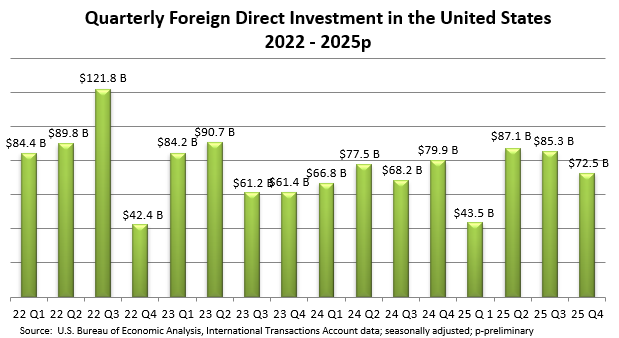
- Foreign direct investment in the United States (FDIUS) reached $72 billion in the fourth quarter of 2025, shrinking 15 percent over the third quarter of 2025.
- Net equity flows registered $23 billion in the fourth quarter of 2025, decreasing 42 percent over the previous quarter.
- Reinvested earnings stood at $51 billion in the fourth quarter of 2025, representing a 70 percent share of total FDIUS.
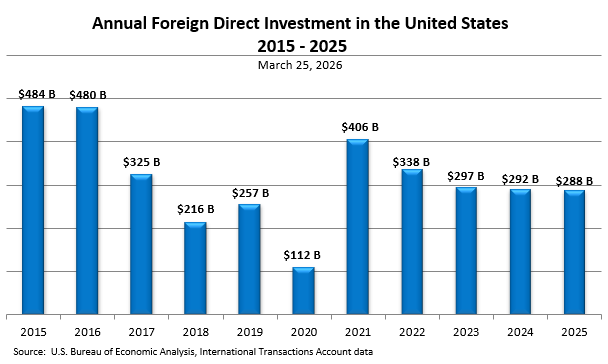
- At $288 billion, foreign direct investment in the United States in 2025 was slightly lower than the decade’s annual average and just a 1 percent decline from 2024.
- Quarterly FDIUS inflows are frequently subject to significant retrospective revisions and can exhibit substantial volatility from one period to the next.
- Despite rising global competition, the United States remains a premier destination for foreign capital. Its vast consumer base, sophisticated financial markets, and robust legal protections continue to draw investors. This influx fuels job creation, drives innovation, and secures America’s competitive edge on the world stage.
Analysis & Context
Foreign direct investment flows in the United States shrank 15 percent to $72 billion in the fourth quarter of 2025. Reinvested earnings made up the largest portion of FDIUS at 70 percent in the fourth quarter of 2025. Equity declined 43 percent between the third and fourth quarters of the year to $23 billion.
Japan and the Netherlands emerged as the leading sources of FDIUS in 2025, contributing $50 billion and $33 billion, respectively, in capital. The United Kingdom, Germany, and Canada rounded out the top five investors, underscoring the continued dominance of established partners in the U.S. market.
Manufacturing dominated FDIUS inflows in 2025 at $126 billion, followed by wholesale trade and information, at $47 billion and $23 billion, respectively. Chemicals ranked as the largest manufacturing segment by FDIUS at $36 billion.
Global FDI climbed 14 percent to $1.6 trillion in 2025, with the majority of inflows directed toward developed economies, according to the United Nations Conference on Trade and Development (UNCTAD). However, when accounting for conduit flows, the net increase was a more modest 5 percent. The investment landscape was heavily shaped by the tech sector: data centers alone represented one-fifth of all greenfield announcement value, while semiconductor projects saw a 35 percent surge. Artificial intelligence rounded out the top three industries for high-value investment announcements.
The broader appeal of the United States as an international destination stems from a unique convergence of strategic assets. This includes a vast U.S. market, access to world-class research universities, and a sophisticated infrastructure that facilitates seamless market entry. Increasingly, international firms are leveraging the United States as a critical global export platform, further bolstered by abundant domestic energy resources that offer a competitive edge in manufacturing and operations.
These investments provide a vital boost to the American economy as international firms establish new manufacturing facilities, strengthen their existing U.S. operations, and aggressively fund domestic research and development activities. Most critically, these companies support 8.7 million Americans through high-quality, well-paying jobs.
According to UNCTAD, the United States secured its position as the world’s top destination for FDI flows in 2025, and remains the leading cumulative market for international capital. However, this achievement comes amid a shifting global landscape; while most nations actively compete for investment, many are simultaneously adopting protectionist measures, including heightened regulatory barriers and more rigorous oversight of cross-border mergers and acquisitions.